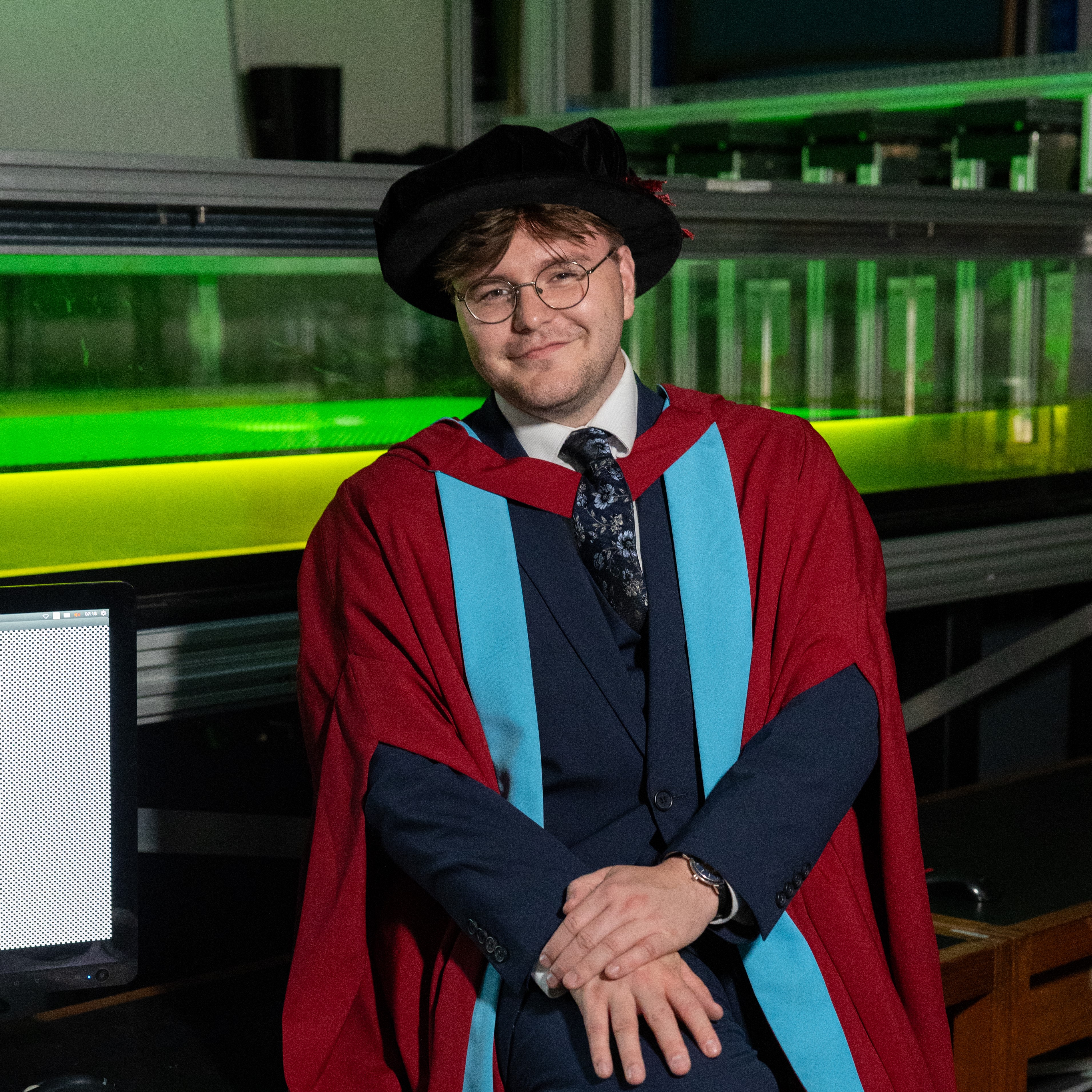
Our very own Dr. Cameron R. D. Bunney has been awarded the 2025 Gravitational Physics Group Thesis Prize. Here is more about his PhD thesis from Cameron:
Einstein’s “happiest thought” was the realisation that the effects of gravity and acceleration are one and the same: if you are in a lift and you feel yourself being pulled down to the floor, there is no way to tell if the lift is standing still in a gravitational field like the Earth’s, or if it is accelerating upwards deep in empty space. This idea is known as the Equivalence Principle.
Strongly gravitating objects like black holes have captured the imagination for decades. Often described as points of no return in the Universe, pulling in everything, including light, black holes are predicted to emit a faint stream of particles and may eventually evaporate completely in a process known as the Hawking effect.
If gravity and acceleration are truly equivalent, then the physics near a black hole should have an analogue for accelerating objects. This leads to the prediction of the Unruh effect. It suggests that if you are standing still in a Universe completely devoid of particles and then begin to accelerate, empty space would seem to come alive with particles. Even more strangely, as you accelerate you would begin to heat up and the faster you accelerate, the higher the temperature you would feel.
The Unruh effect has challenged our understanding of what a particle even is; if you are standing still or accelerating, you will measure different numbers of particles in the Universe. This highlights the fact that what we call a “particle” is not absolute but depends on how you are moving.
Confirming these fundamental predictions remains one of the most important, and experimentally elusive, challenges in modern physics. The difficulty is that they rely on conditions we simply cannot reproduce in a lab: a perfectly empty Universe, at absolute zero, extending infinitely in all directions, and lasting forever.
In my PhD work, I explored what happens when you move away from these idealised conditions and step towards something more realistic. Instead of an infinite and empty Universe, I looked at what changes when there is a background temperature and when the experiment takes place in a finite space. In particular, I asked what remains of the Unruh effect under these more realistic conditions, and how much of it we might be able to observe.