I am pleased to announce that the Relativistic Quantum Information-North (RQI-N) circuit is continuing in 2026, with the lead organiser and our good colleague Rick T. Perche visiting many locations world-wide over the span of Summer 2026 to host one-day-long online workshops. The aim of this is to hear from all partner locations of the RQI-N society in a topic-focused set of talks.
I am even more pleased to announce that this year, following recent relocation of Prof. Silke Weinfurtner and the entire gravity laboratory, Manchester is one of his stops.
During the day you can watch us live, online through the ISRQI Youtube Channel. All talks of the day will also be rerecorded and available on the channel after the conference date.
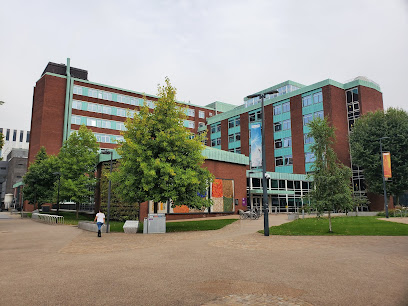
Venue
Niels Bohr Common Room
University of Manchester
Department of Physics and Astronomy
Top (6th) floor of Schuster building
You can get Google Map directions from this link.
Schedule
To see abstracts of the below talks, click on a talk you would like to know more about.
10:30
Arrivals and Coffee (30+0)
11:00
Silke Weinfurtner
"Introduction"
Introduction
Silke Weinfurtner
TBA
11:05
Marion Cromb
"(Quantum) Physics in Rotating Frames (20+5)"
(Quantum) Physics in Rotating Frames (20+5)
Marion Cromb
The way quantum phenomena are affected by the frame of reference in which they occur is deeply connected to one of the most fundamental mysteries - the unification of quantum mechanics and general relativity. Some of the theorised effects are very well known, others less so, and direct experimental tests have been relatively overlooked. I will present experimental work in several different areas: photon entanglement in rotating frames, the amplification of certain field modes by rotating absorbers that lead to 'black-hole bomb' instabilities, and a potential test of the Unruh effect - the transformation of the vacuum to an accelerated observer.
11:30
Chris Goodwin
"Analogue gravity experiments in superfluid helium (20+5)"
Analogue gravity experiments in superfluid helium (20+5)
Chris Goodwin
A new experiment is in development for visualizing the dynamics of the surface of thin films of superfluid 4He. This experiment takes place in a dry, 300 mK 3He refrigerator, and uses a Mach-Zehnder interferometer to realise a combination of off-axis digital holography and heterodyne interferometry as measurement probes of the fluid surface. We have so far categorised the eigenmodes of surface excitations in a cylindrical basin [1] and further hope to also observe surface deformations in the presence of quantized vortex lines terminating at the fluid surface. The thin film serves as an analogue (2+1) dimensional spacetime, with small surface fluctuations playing the role of a scalar quantum field [2]. In the zero-temperature limit, the surface modes become quantized, arising from excitations of small numbers of phonons and are referred to as third sound modes. Using this analogue, the experiment will serve as an environment in which predictions of quantum field theory in a flat (2+1) dimensional spacetime can be tested. Ultimately, our goal is to create an analogue Unruh-DeWitt detector, capable of measuring the changing power spectral density of a scalar field from the perspective of an accelerating observer. The ability to control the geometry of superfluid thin films using temperature control, or applied electric and magnetic fields, also allows the creation of non-trivial effective spacetime geometries, in which analogue experiments can explore predictions of cosmological models. We have also proposed that such a platform would allow for the direct measurement of information theoretic quantities such as area laws of mutual information between coupled effective fields [3]. [1] ArXiv Preprint: 2509.10235 [2] New Journal of Physics 26.6 (2024): 065001. [3] ArXiv Preprint: 2508.07247 *This work was supported by the UK National Quantum Technologies Programme
11:55
Ilaria Dimina
"The Analogue Unruh Effect in Thin-Film Superfluid Helium-4 (15+5)"
The Analogue Unruh Effect in Thin-Film Superfluid Helium-4 (15+5)
Ilaria Dimina
Thin films of superfluid helium are excellent analogue platforms to test for predictions in quantum field theory in curved spacetime and relativistic thermodynamics, since they act as effective (2+1)-dimensional spacetimes. Their surface height fluctuations, also known as third sound, obey a Klein-Gordon equation with propagation speed analogous to the speed of light. We are currently developing an experiment to test for the Unruh effect in these systems. Our aim is to measure a thermal-like spectrum, analogous to that predicted by Unruh, by introducing a laser beam in circular motion through the film acting as a localised, accelerating detector. I will discuss the details of the theoretical model, and its experimental realisability.
12:15
Lunch (60+0)
13:15
Julian Hanby
"Careers opportunities with the gravity lab (15+0, joint with next talk)"
Careers opportunities with the gravity lab (15+0, joint with next talk)
Julian Hanby
TBA
13:30
Ben Carter
(University of Manchester)
"Career opportunities at the University of Manchester (15+10, joint with previous talk)"
Career opportunities at the University of Manchester (15+10, joint with previous talk)
Ben Carter (University of Manchester)
TBA
13:55
Felipe Portales-Oliva
(Theoretical Physics Institute, São Paulo State University)
"Detector model for the ⁴He thin film in different dispersion regimes (20+5)"
Detector model for the ⁴He thin film in different dispersion regimes (20+5)
Felipe Portales-Oliva (Theoretical Physics Institute, São Paulo State University)
The third sound waves in a thin film of helium-4 serve as an analogue for a massless scalar field embedded in a (2+1)-dimensional spacetime, but what do we expect to observe in its spectrum? I will be presenting the expected predictions of the theory for the circular Unruh effect, with an updated detector model, including the formulas and computational results for both linear and modified dispersion of the third sound waves.
14:20
Jorma Louko
"Back-action of an Unruh-DeWitt detector in causal covariant perturbation theory (30+10)"
Back-action of an Unruh-DeWitt detector in causal covariant perturbation theory (30+10)
Jorma Louko
Transitions in a local quantum system in a relativistic spacetime are accompanied by a back-action on the ambient quantum field to which the local system couples. We address this back-action for a pointlike Unruh-DeWitt detector coupled to a scalar field, in scenarios where field observable measurements are not conditioned on a measurement of the detector's final state. We present a second-order perturbative formalism that maintains spacetime covariance and relativistic causality throughout. As an application, we evaluate the renormalised stress-energy tensor of a massless scalar field for the back-action of a uniformly linearly accelerated detector in 3+1 Minkowski spacetime. The energy flux into and out of the detector accounts exactly for the energy gained and lost by the detector in its transitions due to the Unruh effect. For a detector prepared initially in its ground state, we find two regions of negative energy density, one near the acceleration horizon, the other in the far future. We anticipate the formalism to be adaptable to the back-action that occurs in analogue spacetime simulations of relativistic acceleration. (Based on 2512.16217 by A. S. Wilkinson, L. J. A. Parry, J. Louko and W. G. Unruh)
15:00
Coffee break (30+0)
15:30
William G. Unruh
(University of British Columbia)
"Black Hole Entropy: creator or container? (30+10)"
Black Hole Entropy: creator or container? (30+10)
William G. Unruh (University of British Columbia)
Talk by prof. William G. Unruh about their recent work on the Black Hole entropy!
16:10
Breagh Macpherson
"Early Universe Cosmology In The Lab (15+5)"
Early Universe Cosmology In The Lab (15+5)
Breagh Macpherson
Understanding how energy transfers across scales in far-from-equilibrium systems is central to many areas of physics, including the dynamics of the early Universe. Laboratory analogue experiments provide a way to explore such processes under controlled conditions. In this talk, I present a periodically driven two-fluid system in which surface waves are generated and interact nonlinearly, redistributing energy between different modes and leading to cascade formation. The dynamics can be described by a weakly nonlinear Lagrangian framework and are closely analogous to the parametric excitation of fields that occurs during cosmological preheating after inflation. By experimentally tracking the evolution of individual wave modes, we study how these cascades develop, providing insight into nonlinear dynamics in analogue models of early-Universe physics.
16:30
Maciej T. Jarema
"Measuring and manipulating information in QFT simulators (15+5)"
Measuring and manipulating information in QFT simulators (15+5)
Maciej T. Jarema
The encoding of information-theoretic measures, such as entropy and mutual information, across space and time, characterises the structure, history, and complexity of correlations in a system. Accessing information distributions would provide a powerful lens for investigating area laws, thermalization, fundamental communication limits, and non-linear, far-from-equilibrium dynamics. Analogue QFT simulators can provide the necessary observables to assess to these phenomena by emulating field degrees of freedom with high precision and dynamical control. However, a significant hurdle remains: while analogue simulators offer the platform, extracting information requires access to their quantum state. This remains largely out of experimental reach beyond small systems and/or simple states. In this talk, I will present a tomography scheme for assessing the Gaussian information content of thin-film superfluid helium experiments that simulate (2+1)-dimensional QFTs. I will also present experimental measurements of information area laws in strongly interacting ultracold gases that simulate the sine-Gordon scalar field. Finally, I outline our progress toward monitoring information flow and its active manipulation.
16:50
Lucas Tobias de Paula
(Federal University of ABC)
"Trapped surfaces and geodesics in non-axisymmetric analogue black holes (15+5)"
Trapped surfaces and geodesics in non-axisymmetric analogue black holes (15+5)
Lucas Tobias de Paula (Federal University of ABC)
Many phenomena associated with black holes are typically studied under symmetry assumptions, most notably in the axisymmetric Kerr spacetime, where the underlying structure allows for significant analytical simplifications. In contrast, comparatively little is known about how the breaking of such symmetries impacts these phenomena. Analogue gravity systems provide a useful platform to explore these questions in controlled settings. In this talk, I will present the construction and analysis of a non-axisymmetric analogue black hole, focusing on the identification of the effective horizon and its geometric properties. I will then discuss the behaviour of null geodesics, highlighting how propagation and trapping are modified in the absence of symmetry. Finally, I will comment on how these results provide the necessary foundation for the study of superradiant phenomena in such systems, along with some preliminary considerations on the challenges introduced by non-axisymmetry.
17:10
"End of day discussions"
End of day discussions
End of day
17:20
END OF DAY
Participants
Invited Spekers:
Prof. Jorma Louko
Prof. Silke Weinfurtner
Dr. Marion Cromb
Dr. Chris Goodwin
Dr. Felipe Portales-Oliva (Theoretical Physics Institute, São Paulo State University)
Breagh Macpherson
Ilaria Dimina
Maciej T. Jarema
Julian Hanby
Ben Carter (University of Manchester)
Lucas Tobias de Paula (Federal University of ABC)
Prof. William G. Unruh (University of British Columbia)
Additional Information
Lunch, coffee and pastries will be provided for local speakers and invited guests. If you are joining us from a department sent invitation, we will not be able to provide refreshments, but can recommend local cafes and canteen.
Event page credit: Maciej T. Jarema, Ilaria Dimina, Rick T. Perche
Web development and design credit: Maciej T. Jarema
Current website officer: Maciej T. Jarema